


What is The Basketball Pathway Field Guide, and who is it for?
Short answer
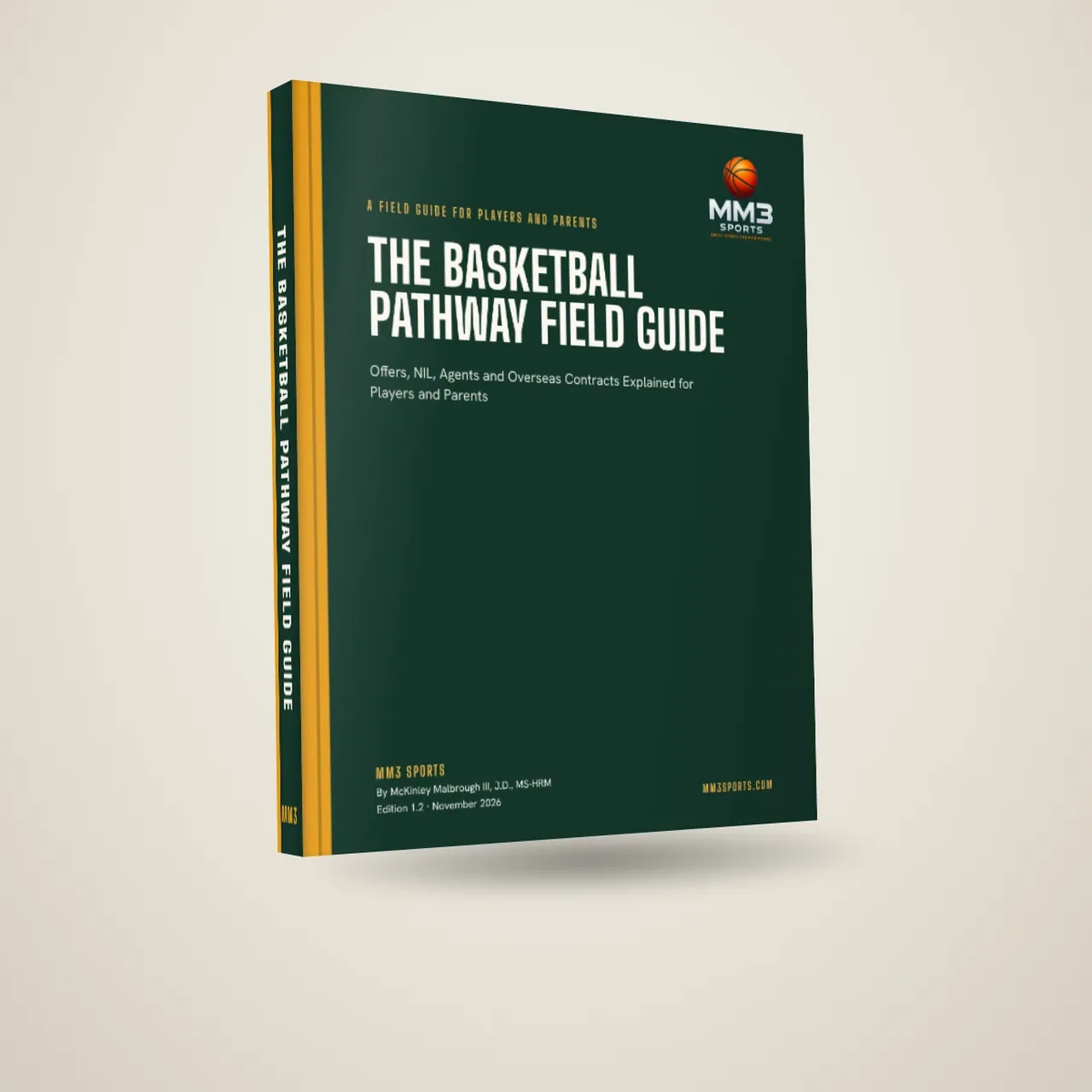
The Basketball Pathway Field Guide is a 12-chapter book by the author for players and parents. It teaches how to read a college offer, outside NIL deals, agent claims and overseas contracts one clause at a time, with worksheets and scripts. It comes as a Kindle book, a paperback and a PDF.
Why did the author write this book?
The author wrote it to explain offers, NIL, agents and overseas contracts in plain words, with the rule, the number and the source for each point. Families meet the biggest decisions in basketball, a scholarship offer, a sponsor contract, an agent's pitch, without a single place to check them. The book is a practical guide, not a theory book. The full title is The Basketball Pathway Field Guide: Offers, NIL, Agents and Overseas Contracts Explained for Players and Parents.
From an agent's seat, families rarely lack effort. They lack one place where the questions, the answers and the dates live, so a verbal promise and a signed page can get treated as if they carry the same weight, when only the written terms count. The book exists to fix that gap.
What problems does each part of the book solve?
The 12 chapters follow a player's path from the first offer to life after the game, and each chapter is titled as the question a family would actually ask, per the Field Guide page. The table shows the questions, not the answers.
| Stage | Questions the chapters ask |
|---|---|
| College offers | Is this the whole offer? What should a recruiting plan look like? How do you compare programs when every visit feels great? |
| NIL and contracts | What must an athlete report about outside deals? How do you read any basketball contract, one clause at a time? |
| Agents and advisers | What are the red flags? Who is allowed to represent you? How do you vet an agent before you sign? |
| Pro and overseas | How do you choose a path after college? What should you know before an overseas contract? How do you turn an offer into a take-home number? |
| After the game | What comes next, and how do you start before the career ends? |
The rules behind several of these questions already have their own explainers on this site. Comparing multiple college offers and how NIL Go approves deals cover the rule side. The book covers the part those articles cannot: what a family does with the rule on a Tuesday night with an offer on the table.
What makes it a field guide and not a textbook?
Every chapter is built to be used, not just read. Each one opens with a short answer, explains the idea and why it matters, gives numbered steps, and then shows the idea at work in three made-up scenarios labeled as illustrations. Each ends with a recap and a short "Do this week" list in which every step carries a time and a finish line.
The back of the book holds the working tools: a 30-day action plan, copy-ready worksheets, word-for-word scripts for the hard emails and calls, a plain-word glossary, and a sources page with the date each source was checked. The book keeps the steps, the checklists and the exact wording for readers, and this article does not reproduce them.

Who should read it, and where should each reader start?
The book works as a basketball recruiting book for parents and a business guide for players, and it does not assume any contract or sports law background. It suggests three starting points: high school players begin with Chapters 1 to 7, players finishing college or weighing pro options begin with Chapters 7 to 12, and parents find Chapters 1, 4, 5, 6 and 7 most useful at first.
I built the College Offer Comparison and Negotiation Toolkit for readers in this spot. A toolkit for comparing college offers side by side and negotiating them.
Readers who want the recruiting basics before opening the book can start with how to get recruited for college basketball. Readers who already have an agent's name in hand can pair the book's agent chapters with how to verify an NCAA certified or state registered agent.
How does the book stay accurate, and what does it leave out?
Every rule in the book comes from a primary document, opened and read on the date shown on the sources page. Those include the NCAA Uniform Athlete Agents Act page, the NBPA agent FAQ and FIBA Internal Regulations Book 3, each checked on November 1, 2026 per the book's sources page. Rules change, so the book tells readers to write down the date they checked a rule.
The book also states its limits. It gives no pay figures, tax rates or odds of reaching any league, and the figures it does cite are rule amounts from official documents, each with the date checked. It promises no scholarship, contract or roster spot. It is education, not legal, tax or financial advice, and the author holds a J.D. but is not a licensed attorney. Its notice discloses that chapter drafts were written with the help of an AI model and then reviewed and edited, and that the scenarios are made-up practice examples, not past client results.
Where can you get the book?
The book is sold in three formats. It is available as a Kindle book on Amazon, as a paperback on Amazon and as a 77-page PDF download for $19 on the Field Guide page, per that page.
Pick the format you will actually use at the kitchen table. The paperback suits a parent who wants to mark up pages with a pen, the Kindle edition suits a player reading on a phone, and the PDF suits a family that wants to print the worksheets. Have the book open before the next offer, call or email arrives.
Sources
- The Field Guide, MM3 Sports
- The Field Guide, Kindle edition, Amazon
- The Field Guide, paperback, Amazon
- NCAA: Uniform Athlete Agents Act
- NBPA: Certified Agents frequently asked questions
- FIBA: Internal Regulations Book 3, Players and Officials
Data current as of November 8, 2026. Figures are linked where each one appears. Leagues and regulators update these rules; check the source before relying on a number.
Related questions