

Can LED glass basketball courts solve the arena revenue and player safety problem?
Short answer
LED glass courts can sell sponsors a surface that changes every minute, and FIBA now allows them at its top-level events from October 1, 2026. The open problem is traction: the Big 12 swapped its glass court for hardwood mid-tournament in March after a player slipped. Buyers should demand test data before they sign.
What problem is a static wood court creating for arenas and players?
A wood court has one look and one job. The lines are painted, the logos are fixed, and changing the floor between a basketball game and a concert takes a crew and a night. For a front office that sells sponsorship, the largest flat surface in the building is also the least flexible one. For a player on a crowded international calendar, the floor is a daily load on feet, knees and hips, and nobody outside the training room can see how much.
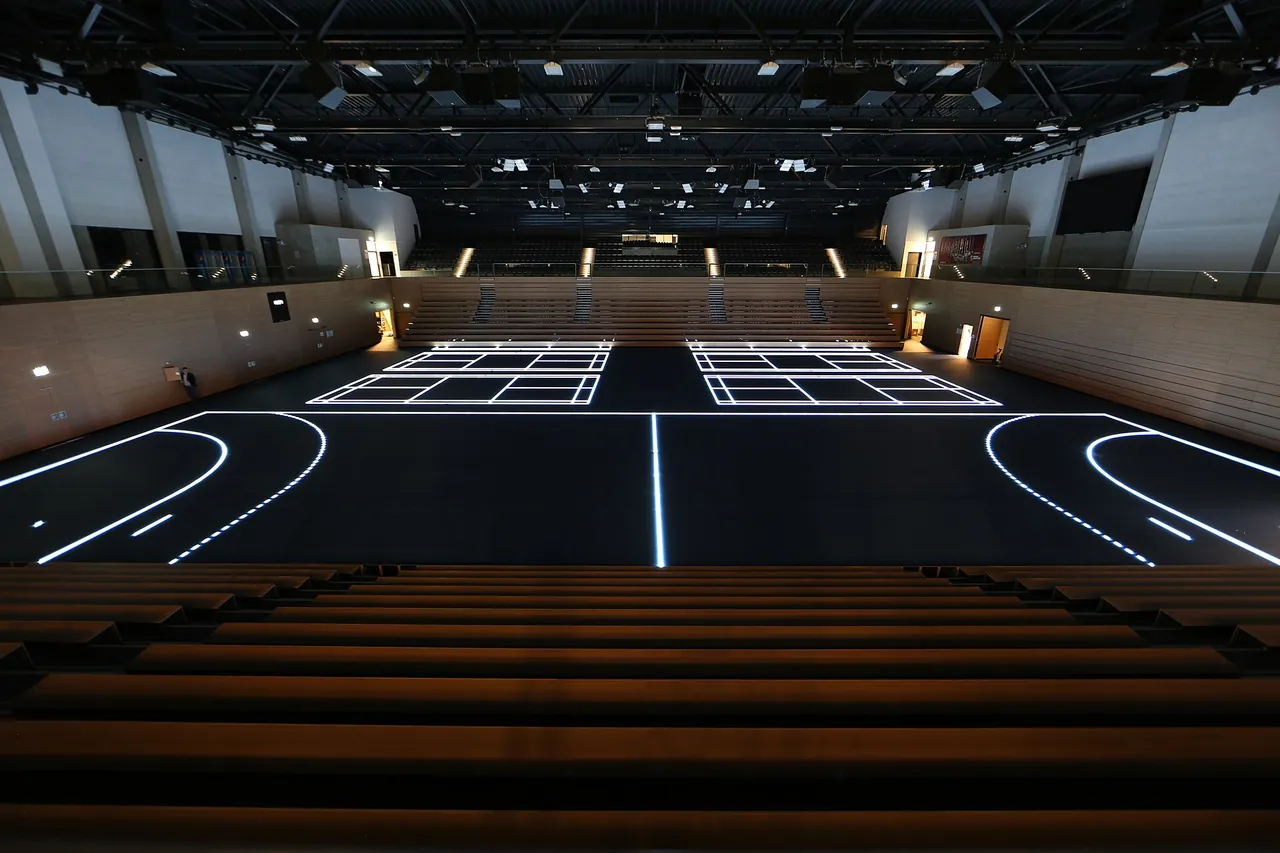
That is the pitch behind LED glass flooring: a surface with video under it, so one floor can show regulation lines for a game, a sponsor animation for a timeout and a tactical overlay for practice. The pitch is real, and so is the first big failure. This guide lays out what has happened since late 2025, what the claims are, and what each person in the business should do about them. Nothing here is a purchase recommendation, and the author has no commercial tie to any floor maker.
What has actually happened with ASB GlassFloor since late 2025?
The record is short and mixed. ASB opened Athletes Lab 2.0 in Orlando in November 2025, twice the size of its first lab, with a hardwood court and a full-LED glass court side by side so teams can compare them, per SVC. The lab was developed with the NBA, and NBA teams can use it for practice.
Four dates that shape the LED floor decision
What happened, in order
- Nov 2025Orlando lab opensASB Athletes Lab 2.0 pairs hardwood and LED glass, developed with the NBA.
- Mar 2026Big 12 pulls the glass courtA slip in a quarterfinal leads to hardwood before the semifinals. FIBA approves glass for Level 1 the same month.
- Jun 2026EuroLeague sells floor inventoryThe Final Four in Athens runs branded moments on the surface for the first time at league level.
- Oct 1, 2026FIBA rule takes effectOrganizers of Level 1 events may choose approved wood or approved glass.
Sources: SVC, Athletic Business, ASB GlassFloor and Sports Travel Magazine, linked in the text.
The Big 12 episode is the part every buyer should read twice. Texas Tech guard Christian Anderson strained his groin in a quarterfinal when his foot slipped on an inbounds play. The conference replaced the glass court with its 2025 hardwood court overnight, before the semifinals, per Athletic Business. Commissioner Brett Yormark said the change gave players "the greatest level of comfort," and he also said he remains "a lover of the LED court." ASB's chief executive said the company saw more player inconsistencies in Kansas City than at its other venues and is running scientific testing.
Is a glass court safe for players, and what is the evidence?
The honest answer is that the public evidence is thin. ASB says its LumiFlex court has "advanced impact absorption and precision traction that protect joints, knees, and ankles," per SVC. That is a manufacturer claim, and the coverage gives no test values or method behind it. NBA players have praised the floor in public, and a Kansas State forward called it a bad floor that should not return, per Athletic Business. Both views are on the record.
FIBA's decision matters here. Its Central Board approved LED glass flooring for Level 1 competitions in March 2026, effective October 1, 2026, per Sports Travel Magazine. Two ASB products, MultiSports and LumiFlex, are approved by the FIBA Equipment and Venue Centre. FIBA approval is a floor-level standard, and the Kansas City slip is a reminder that one venue, one installation and one game night can still go wrong. Treat approval as the entry ticket and ask for the venue-specific data after it.
Hardwood or LED glass: the trade-offs
What each one sells and what it still has to prove
Hardwood
- Known traction and a long record at every level
- One look: painted lines and fixed logos
- Slow changeover for other events
LED glass
- New sponsor inventory and live overlays
- Traction record is short and contested
- Install time and price are not public
Projection on wood is the budget route. Luxedo reports a starting price near $50,000, per Athletic Business.
Does the revenue case hold up?
The revenue case is stronger than the safety case, but it has less data. At the 2026 EuroLeague Final Four in Athens, ASB's content team ran branded moments tied to dunks, three-pointers and timeouts on the floor itself, the first time the league introduced its own inventory on the surface, per ASB GlassFloor. Panathinaikos and Bayern Munich had already adopted the floor. The release gives no audience, viewership or revenue figures, so the dollar value of that inventory is unpublished.
The cost side is also thin. The Athletic Business report does not disclose what the Big 12 paid, and it notes that industry sources want installation time cut sharply before venues that change layouts often can use an LED floor. It also covers a cheaper route: Luxedo court projection starts at about $50,000 with at least four projectors and is used by roughly 150 high schools, with one school reporting a payback of one to two years. For many programs, projection is the realistic version of an interactive floor.
What the public record shows on each claim
Longer bar means more published evidence. This is the author's reading of the sources, not a measured score.
Scores are editorial estimates of how much public evidence exists, not performance ratings of any product.
What about an NBA glass court in 2027?
No NBA team has announced a glass game court for 2027 in the sources the author checked. The confirmed NBA link is the Orlando lab, which the NBA helped develop and which NBA teams can use for practice. Some coverage describes a wider 2027 push into team practice facilities, and that claim is not confirmed by any source here, so treat it as unverified until a team or the league says it. For a sponsorship manager, the useful question is not whether glass is coming. It is which surface you would be willing to put your own players on for 82 games.
How can insiders solve this today?
Use the same four checks no matter which floor is in the proposal: traction data from the specific venue, FIBA approval level, installation and changeover time, and a written revenue case with sponsors named. The author built contract and budget tools for exactly this kind of decision, and they are linked below.
Built for this situation. The Overseas Contract Questions Checklist includes the facility and conditions questions to put to a club, and the Overseas Season Budget and Take-Home Planner helps price what a season on any surface costs you.
How insiders can solve this today
One move for each role this month
Players
- Ask the club which surface you will play on and request its traction and injury-monitoring plan in writing
- Log foot and groin complaints on any new surface and share them with the performance staff
Coaches
- Run a practice on the new surface before game day and note footing on cuts and inbound plays
- Request the venue test results ASB says are underway
Agents
- Add a surface clause to overseas offers: approved floor type and a right to raise concerns
- Check who is liable for a surface-related injury before you sign
Front office and staff
- Price the sponsor inventory with named buyers before you pick a floor
- Ask for installation hours, changeover time and a warranty in the quote
These are practical prompts, not legal or medical advice.
Frequently asked questions
- Is LED glass flooring approved by FIBA?
- Yes for Level 1 competitions. FIBA's Central Board approved it in March 2026, effective October 1, 2026, and two ASB products are approved by the Equipment and Venue Centre, per Sports Travel Magazine.
- Why did the Big 12 remove its LED court?
- After Texas Tech guard Christian Anderson slipped and strained his groin in a March quarterfinal, the conference installed hardwood before the semifinals, per Athletic Business. ASB says it is testing the surface.
- Is an NBA glass game court planned for 2027?
- Not in any source the author found. The confirmed NBA link is ASB Athletes Lab 2.0, which the NBA helped develop and NBA teams can use for practice, per SVC.
Keep reading: how FIBA and INTERSPORT plan year-round merchandise and how FIBA is certifying video and tracking tools.
Sources
- Athletic Business: How the Big 12 decision to replace a glass LED basketball court may affect the technology
- Sports Travel Magazine: FIBA approves LED glass flooring at Level 1 competitions
- ASB GlassFloor: New sponsorship inventory at the EuroLeague Final Four
- SVC: ASB Athletes Lab 2.0 in Orlando, in partnership with the NBA
Data current as of November 13, 2026. Figures are linked where each one appears. Leagues and regulators update these rules; check the source before relying on a number.
Related questions
What does FIBA stand for, and what does it do?
October 17, 2026
Overseas and FIBAHow do overseas basketball contracts work?
September 26, 2026
October 23, 2026How do American players adjust to playing basketball overseas for the first time?
The first months overseas are mostly about daily life, not basketball. Research on migrant athletes finds language, making friends and living away from family among the hardest items. The author…